
Your words matter. The environment you create for your classroom matters. As a language teacher, you have the ability to create an environment that is engulfed in the language and culture from the very first moment of class to the last. Greeting your students every day in the language and teaching them how to respond to instructions in the target language are both important parts of this environment. As an immersive learner myself, it was the constant repetition (input) and the constant opportunity to give output that really helped my proficiency grow. It was repetition that became habitual—especially when the repeated phrases had a usefulness and meaning for me.

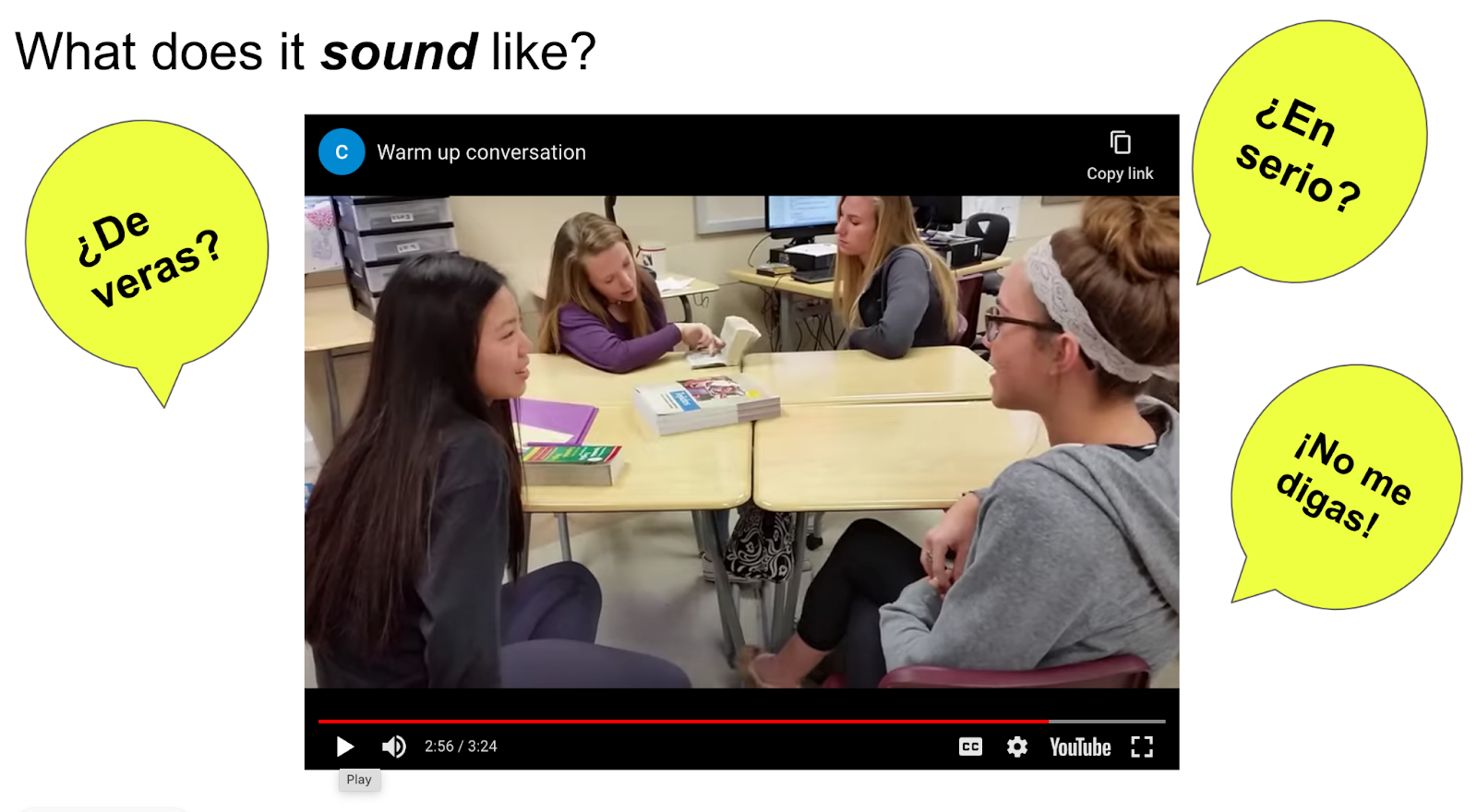
I love to teach my students little phrases that I found super helpful as a language learner. Phrases like, “No me digas,” “¿En serio?” and “¿De veras?” [No way! Seriously? Really?] For me, these were the phrases that I could throw in any conversation and sound more authentic—and they worked for every situation. So I began challenging my students to find ways to use these in every conversation. My students picked them up quickly, and they became staples for any conversation. These phrases also created a lot of laughs when I would remind them of a quiz coming up and they would respond using their new favorite phrases: Really? Seriously? No way! Or when I would look at their unfinished homework and respond likewise. These phrases became part of our class culture, and we used them all the time.
Likewise, I end my class with the phrase “¡Qué tengan un buen día!” and teach them how to respond, “¡Qué tengas un buen día!” [Have a nice day!] In this case my purpose is twofold.
- I want to provide them with a real-world way of leaving a conversation and walking out of a room. It’s polite.
- I want to expose them to more complex grammar without them knowing it. Eventually I will teach them about the subjunctive, and they will easily make the connection because they will have used it over and over by then.
Here is what I’ve noticed. In the beginning, I have to explicitly ask them to respond to me every day with this phrase. I explain that I see them more than I see my own children and that it’s a very polite way to leave my classroom. I remind them—a lot. After the first three or four weeks, it becomes a habit. I don’t have to remind them anymore, and sometimes they are reminding me. When they come in for tutorials, when they come in to ask me something, when they drop by to share something with me, they always leave my room the same way: “!Qué tengas un buen día!” It is music to my ears. They like to tell me stories of how they used the phrase when they left a Spanish-speaking business or a recent conversation they had with Spanish-speaking friends. Students who learned a lot and students who struggled all year long are proficient at “¡Qué tengas un buen dia!” and they love it. But the best part is, when former students visit me to tell me about college or a study abroad they are doing, their last words before leaving my room are “¡Qué tengas un buen día!”

It keeps me wondering what other language habits I can help create. What phrases do you incorporate in your class that have real-world meaning and purpose?

 Seidlitz Education
What a thoughtful and practical article! I loved how you described the power of selecting small, purposeful phrases in a Languages Other Than English (LOTE) classroom, not just random vocabulary, but phrases that students can immediately use, that become part of the classroom culture, that reinforce both communication and grammar naturally. The idea of greeting students each day in the target language, teaching responses, making repetition habitual, this isn’t flashy, but it works and builds authentic proficiency over time. I appreciated your insight that the environment and repeated meaningful output matter more than isolated drills. For teachers of language learners, your article offers both inspiration and concrete strategies. Thank you for sharing.
LikeLike