To those who expect language acquisition to be entirely effortless, I say, “Good luck with that!” Effortless is not the same as joyful. I absolutely believe that language learning has to bring joy, but it may also require some effort on the part of the learner and some carefully crafted linguistic opportunities on the part of the teacher because the language acquisition process at the age of fourteen simply does not look the same as it does at the age of three.
Steven Pinker, my favorite linguist, writes that “between the age of late twos and the mid-threes, children’s language blooms into fluent grammatical conversation” ( Freeman & Freeman, 2004, p. 7). In contrast, after five years of sweat, blood, and tears at the linguistic university back in Russia, two degrees from US universities, and twenty-five years of living and teaching in the United States, I still make some language acquisition errors that a three-year-old native speaker of English would not make. Although we know not to set sights on immediate and flawless accuracy in language learning, inching our way toward clarity of expression requires conscious, focused effort and—drum roll, please—continuous error eradication.
Interestingly enough, authentic settings often deprive learners of the opportunity to notice and correct errors, especially grammatical errors. When you use a wrong word in a conversation, for example, you may read confusion in the face of your interlocutor, which would prompt you to analyze your utterance and self-correct. Most grammatical inaccuracies, on the contrary, go unnoticed by the speaker unless they cause a major breakdown in communication. The receiver can easily understand you when you misuse articles, prepositions, and even verb tenses because these features carry little communicative value. (By the way, this has nothing to do with whether those features occur in students’ L1 or how frequently they occur in English.) Therefore, the speaker goes uninterrupted, unaware, and uncued to self-correct. In addition, there is a social aspect: it would be a major faux pas to correct someone’s grammar in a social setting. Even my friends whom I have asked and begged to correct me do not do it.
The only place where corrective feedback is welcome and expected is a classroom. However, even there, teachers are often hesitant to provide corrective feedback.
Types of Feedback
Teachers know to avoid overcorrecting English learners’ pronunciation or grammar since too much focus on accuracy impedes fluency. Communication is our goal, and we want to build students’ confidence. We search for a way to deliver feedback without damaging students’ sense of linguistic self. At the same time, feedback takes time and effort; therefore, if we are to offer feedback, we want to know that it actually helps students to grow language. Let’s look at a few types of feedback and their effectiveness.
Recast
Recast is a type of feedback where the teacher repeats everything the student said but corrects the error without drawing explicit attention to it. During the recast, the teacher does not require the student to repeat the corrected version.
Student: The causes of the American Revolution was unpopular laws and taxes.
Teacher: The causes of the American Revolution were unpopular laws and taxes.
Explicit Correction
Explicit correction requires the teacher to explicitly point out what was wrong before correcting it.
Student: The causes of the American Revolution was unpopular laws and taxes.
Teacher: The word was is wrong here. You should say, “The causes of the American Revolution were unpopular laws and taxes.”
Metalinguistic Feedback
Metalinguistic feedback requires explicit correction and labeling the error using grammatical terms.
Student: The causes of the American Revolution causes was unpopular laws and taxes.
Teacher: Can you correct the verb?
Student: Were. The causes of the American Revolution were unpopular laws and taxes.
Teacher: Correct.
Is Corrective Feedback Effective?
Yes. If the students notice it!
The most common type of feedback in classrooms is recast, and quite ironically, “recasts appear to go unnoticed by learners” (Lightbown & Spada, 2012, p. 142).
Students who are conditioned to pay attention to form (such as in an ESL or world language classroom where grammar and accuracy are valued) benefit from recasts because they expect to hear the correction and are trained to pay attention to it. In a meaning-based classroom (for example, a sheltered instruction classroom), where attention to form (accuracy) is not emphasized, students tend to miss recasts.
Lightbown & Spada (2012) point out that “students receiving content-based language teaching (where the emphasis is on meaning not form) are less likely to notice recasts than other forms of corrective feedback because they may assume that the teacher is responding to content rather than the form of their speech” (p. 141). In other words, students who are used to listening for meaning alone see the teacher’s recast as a confirmation that their answer is correct. They simply do not notice that there was a correction of form.
What Can Teachers Do to Increase the Effectiveness of Recast?
Although a self-contained classroom of English learners in a language development course would be the best place to offer more explicit correction and metalinguistic feedback, content-area classroom teachers will most likely continue to use recast. However, knowing the importance of noticing, could we add “good teaching techniques,” aka “language-focused pedagogies,” to increase the effectiveness of recast? Absolutely!
One way to increase the effectiveness of a recast without singling out the student who made the error is to ask all students to repeat the response recast by the teacher chorally.
Nancy Motley, in her book Small Moves, Big Gains, suggests practicing a teacher habit called “Package and Parrot,” which consists of the following components: recast and chorally repeat.
Package is the student’s response “packaged” by the teacher into a correctly structured sentence (the essence of recast).
Parrot is the choral repetition by all students.
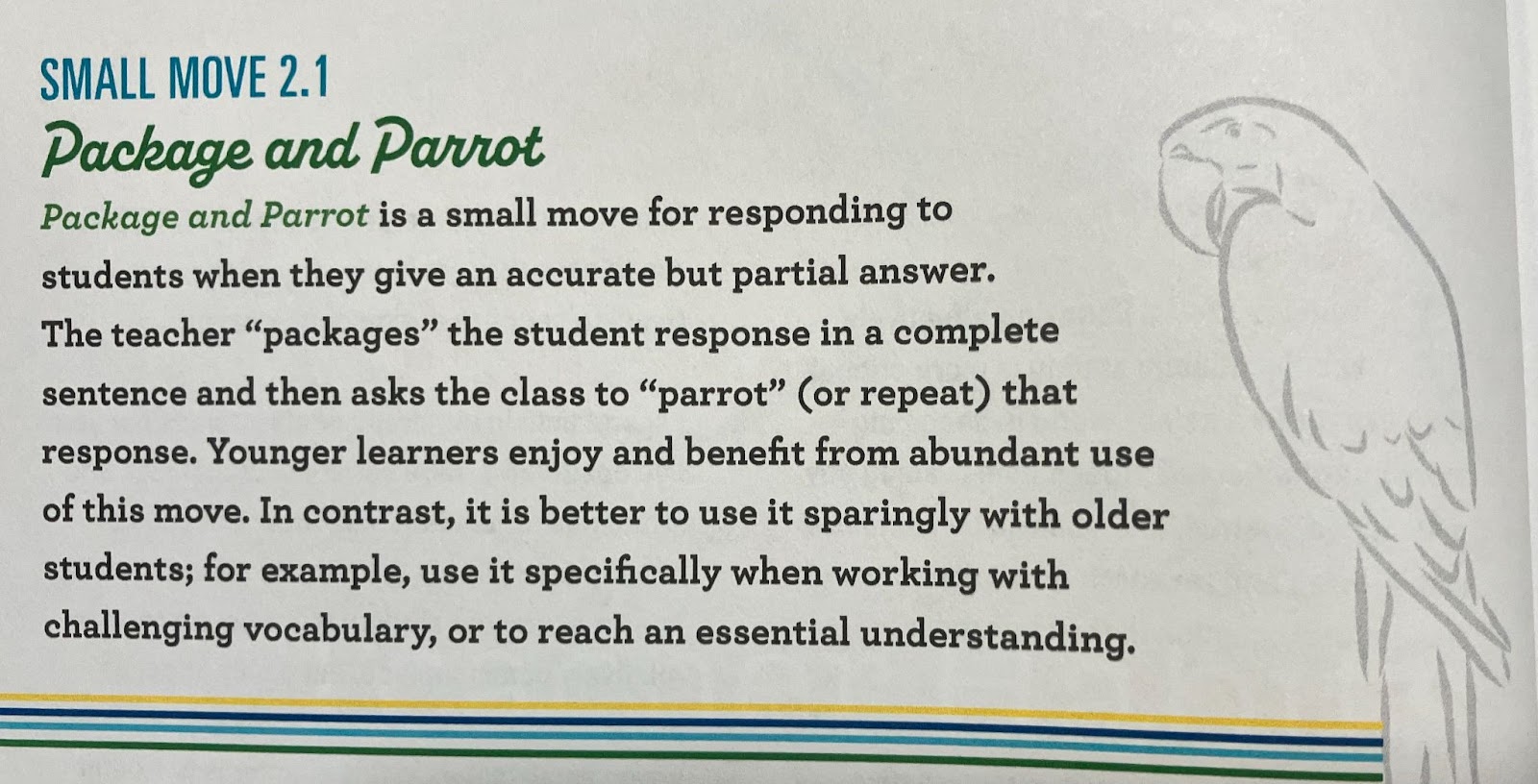
(Motley, 2022, p.24)
Suggested by Motley as a move for responding to partial answers, this technique appears to be quite appropriate for enhancing the acquisition of other language features as well. The technique might not rise to the level of effectiveness of explicit correction or metalinguistic feedback (the kids might be repeating things without truly understanding what they are repeating), but it is definitely doable for all teachers in all classrooms. And it is definitely better than recasting alone. So give it a try!
Not on ELAR teachers’ shoulders alone:
In 1998, linguists conducted a study with a group of ESL learners in their science class consisting of middle school children.Students received corrective feedback on past tense and conditional verb forms during oral and written work on science reports (Lightbown & Spada, 2013). These students showed more progress in the accuracy of verb usage immediately during the two months after the study. Therefore, offering corrective feedback should not be on ELA teachers alone—it should happen in all classrooms!
Bibliography
Freeman, D., & Freeman, Y. (2004). Essential linguistics: What you need to know to teach reading, ESL, spelling, phonics, and grammar. Pearson.
Lighbown, P., & Spada, N. (2012). How languages are learned. Oxford University Press.
Motley, N. (2022). Small moves, big gains. Seidlitz Education.

 Seidlitz Education