When I became an educator ten years ago, it was in the wake of a concerted push within the education community to shift away from deficit-minded language toward more asset-based language, particularly in the service of students acquiring English proficiency. I felt a sense of pride and optimism that we had almost completely shifted away from the deficit-based label, “Limited English Proficiency” (LEP), toward the more asset-based label, “English Language Learner” (ELL).
As soon as the new label was implemented, however, the discussions about it began. Doesn’t the label still imply that the students are “catching up” to their English-speaking peers? What about the role of culture? Shouldn’t the label reflect the fact that the student is advancing beyond their monolingual peers by developing multilingualism?
In Texas, where I am based, the state education code (Code, 2020) has shifted within the past six years from ELL as its official label to “English Learner” (EL) to, most recently, “Emergent Bilingual” (EB). While EB is very asset-based, it disregards the many students who are already bilingual or trilingual in other languages in addition to the English they are acquiring. Many educational groups, including the WIDA consortium, have adopted “Multilingual Learner” (MLL), while others have incorporated “Culturally and Linguistically Diverse” (CLD) learner. These labels are also not perfect. While CLD addresses culture in a way that MLL and EB do not, it has been criticized for excluding white, monolingual, English-speaking students as contributors to the cultural and linguistic diversity of a classroom (Wright, 2019). So the debate continues.
All of these labels — ELL, EL, EB, MLL, CLD — are in widespread use today and are often used interchangeably (for the purpose of this blog post, I will use EB from here on out). All are good labels, but none are perfect, and lately I’ve been wondering if the debate about labels has sometimes missed the point about their purposes and limitations.
To be clear, identifying and labeling students who are acquiring English proficiency has enormous benefits. This is a subpopulation which has historically been underserved and which has specific needs. When we break down testing data by subpopulation and see that EBs are less successful in some classrooms than the general population, we can incorporate language scaffolds and language-specific teaching strategies into those classrooms that bridge the equity gaps and enhance learning for all students. Recent research has shown that incorporating the language-rich strategies of the 7 Steps model into classrooms has a significant impact on the learning of EBs (Seidlitz & Perryman, 2021).
But labels can also otherize and stigmatize students. When we label a student as “EB,” while referring to monolingual English-speaking students as simply members of the general population, we are treating that student as different from the norm rather than as part of the diversity that is the norm. After all, EBs have much more in common with non-EBs than they have differences. There are EBs and monolingual English-speaking students who are both reading in English below grade level, for example, and both would benefit from the same reading scaffolds. And there are EBs and non-EBs who visualize math problems similarly, or who can relate similarly to a character in a story. But we miss that if we focus too much on the EB label and don’t see them as students first.
Labels can also underserve the students they are meant to serve by generalizing them. For example, we might identify an EB that is testing below average and prescribe language supports for that student. The student might need these language supports, but they might also be testing below average because of unmet socioemotional needs, or because they need tutoring on a specific academic unit. Thus, it is important that we don’t allow a label to conflate a subpopulation’s general needs with the holistic needs of an individual student.
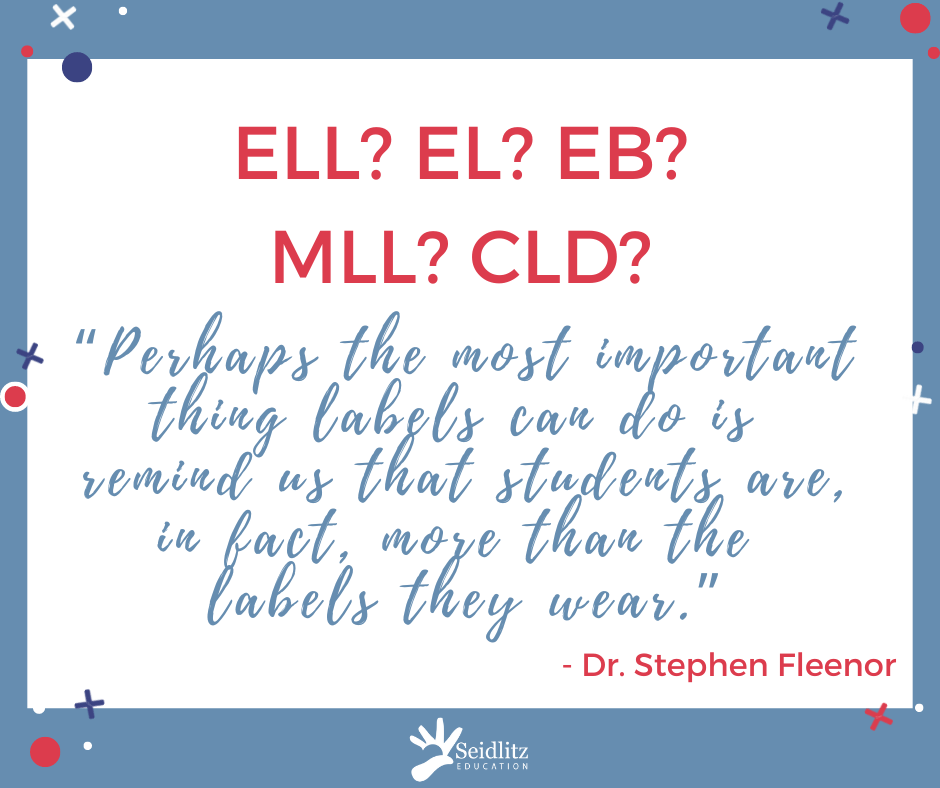
Labels are not going away, nor should they. Neither should the debate about which label is most appropriate. But perhaps the most important thing labels can do is remind us that students are, in fact, more than the labels they wear, and every classroom has diverse needs and diverse assets independent of its labels. Indeed, all students are academic language learners, and a diverse classroom benefits from a variety of language supports. And every student brings a unique background to the classroom, which can be fostered through open-ended questioning and student-centered instruction. Ultimately, we serve our students best when we value their assets and embrace the diversity they bring to our classrooms.
Dr. Stephen Fleenor is a scientist-turned-educator who is inspired by the principles of sheltered instruction and growth mindset, particularly in the advancement of academic language in content-area classrooms. As the Chief Digital Officer at Seidlitz Education, Dr. Fleenor drives development of language-rich digital resources for content-area teachers, including production of instructional technologies and, most notably, The Visual Non-Glossary.
Code, T. A. (2020). Chapter 89. Adaptations for special populations. Subchapter BB. Commissioner’s Rules Concerning State Plan for Educating Limited English Proficient Students. (TEC 29.051-29.064).
Seidlitz, J., & Perryman, B. (2021). 7 Steps to a Language-Rich, Interactive Classroom. Seidlitz Education.Wright, W. E. 2019. Foundations for Teaching English Language Learners: Research, Theory, Policy, and Practice. 3rd ed. Philadelphia, PA: Caslon Publishing.

 Seidlitz Education
One thought on “ELL? EL? EB? MLL? CLD? How Labels Help — and Hurt — Students”