by Sally Barnes
This year, there’s a new rule in classrooms across the United States: Many state legislatures or local districts have banned cellphones and related devices in schools. With this change comes so many benefits, but also a few challenges. What do we do with students who were compliant (quiet, nondisruptive) because of their phones, but now don’t have their device at their disposal? What does this mean for classroom behavior, free time, peer-to-peer socialization, and expectations for bell-to-bell work? The truth is, I don’t want my kids to be compliant. I want them to be engaged in our class. So, how do we move kids from compliant to engaged? What does that mean day-to-day?
In 2024 and 2025, I participated in a professional learning cohort called Leaders in Language Learning (LILL). I learned so much from my world language colleagues from around the country, and one message in particular resonated with me so completely that I’ve been wrapped up in the idea ever since.
Leo Valladares, one of the cohort leaders, asked us to imagine we were in a piano class with 30 students and one piano. We’re getting called up one at a time to practice our scales while the rest of the class watches. In this scenario, we (as students) are never going to learn how to play. While one student is up practicing, the rest of us are anxious, bored, disengaged, and distracted. On the flip side, if we were to walk into a room with 30 students at 30 pianos practicing simultaneously, we’d see 30 students with their hands on the keys, actively participating and engaged in the task. We’d hear 30 students improving their skills. And really, isn’t that what we want for our kids? Everyone involved, everyone learning, everyone progressing at their own pace? As Leo says, we want all kids “doing,” all the time. So, what does that really look like in our classrooms?

First off, “doing” looks different in every class, for each lesson. “Doing” might mean reading a passage, listening to a lecture, taking notes, or drawing a picture. Whatever “doing” might be, I’m always on the hunt for the lowest-prep way to make it happen as often as possible. For example, why would I ask one student to respond to a question when every student could tell their partner the answer? Why would I read the instructions on the board when every student could read them chorally? Why would I ask one student whether they agree or disagree with a statement when every student could show me with a thumbs-up/down or by moving to one side of the room?
Some low-prep examples of “all kids doing, all the time” in our classrooms could be:
- Nonverbal total response signals to show understanding and readiness.
- Thumbs-up/down for agree or disagree.
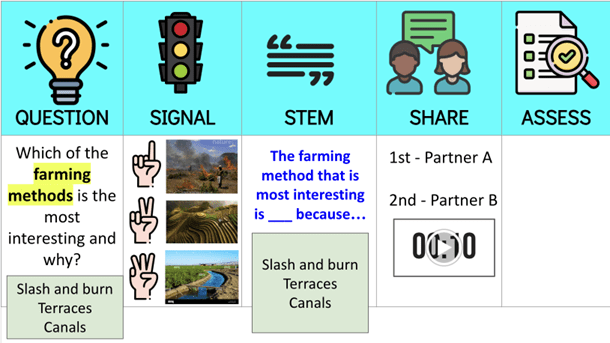
- Show 1, 2, or 3 based on the presented options to give an opinion or match pictures to vocabulary (see picture 1).
- Move to a corner based on which image or concept does not belong.
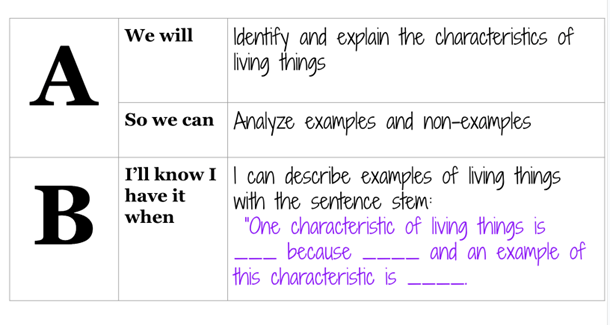
- Choral reading or partner reading short texts like instructions, objectives, sentence stems, word problems, and definitions (see picture 2).
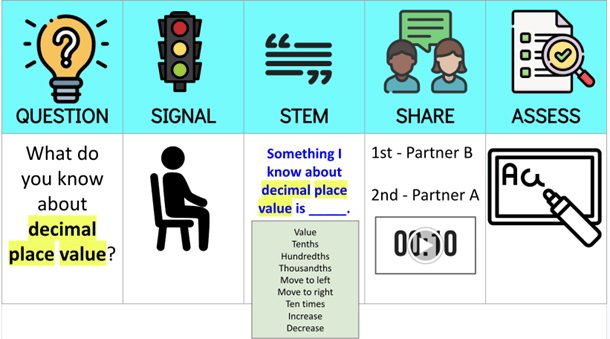
- Have students write their answers on a whiteboard and hold it up for the teacher to see (picture 3).
- QSSSA for structured conversations.
- Ask all students to write a sentence, then read it to two classmates.
(Tip: These same strategies work when facilitating professional development for adults! We all need opportunities to meaningfully engage and reset our attention!)
Now, back to the 30 pianos. In the first classroom (one student playing, 29 observing), there is a clear sense of control. There is limited noise, and it is easier for the teacher to give individualized feedback to the student at the front. However, most of the students are disengaged. This may look like a compliant classroom, but it may not feel as effective day to day. In the second classroom (30 students with pianos), it is undoubtedly louder. The teacher is bound to be rotating and actively monitoring throughout the room. In this classroom, though, students are much more likely to be engaged. Personally, I’d prefer to try to engage 30/30 students (heck, even 25/30) than 1/30.
With that in mind, clear procedures and expectations need to be in place for this type of classroom to be effective. Some of these procedures/expectations may include the following:
- Establish a call/response to bring the class back together. My go-to is “Raise your hand if you can hear me,” as I slowly make my voice quieter and quieter.
- Remind students of noise-level expectations and consistently review the noise-level norms.
- Add timers to these tasks and keep the times tight. I use timers with sound effects in the last 3 seconds to bring students back together, and I often err on the side of adding more time to complete the task than having too much time on the timer to begin with.
- Keep the routines clear and tight. Use consistent slide templates, recycle instructions, establish and maintain precision partners, and identify a clear order when necessary (ex, Partner B speaks first, then Partner A). Regularity can help students succeed within a set structure.
- Post the instructions on the board so students can refer back to them without asking the teacher for help (though this will definitely take practice).
Another colleague of mine, Bethanie Drew, gave an incredible message about motivation at SCOLT ‘24. She said, “Confidence and perceived competence are incredibly important components of motivation. Students must have confidence to participate in class and feel they will likely be successful in the task.” When it comes to this kind of frequent, structured engagement, my mind immediately pivots to these components of motivation. How do I use these moments of “everyone doing, all the time” to enhance their confidence and perceived competence, and therefore their engagement?
In my classroom—and even when I work with adults—I think of these smaller instances of total participation as resets or “little wins.” I strategically place these opportunities throughout my lessons where I may need to “bring students back” who have gotten sidetracked, or reignite the motivation in all students after a particularly difficult task. I want to tap into their confidence and perceived competence so they feel like they can and will be successful – even if it’s just for a short turn and talk or a nonverbal signal.

Ultimately, the idea of “all kids doing, all the time” requires me, as the teacher, to think about creating opportunities for strategic inclusion and total participation throughout my lessons – especially in low-prep, low-stress, minute-or-less moments. I want to find as many opportunities to embed these “little wins” or resets throughout the class to increase motivation, boost confidence, and maintain consistently high engagement. I am determined to find chances for all students to “put their hands on the piano keys” as often as I can.
What are your favorite ways to get “all students doing” in your class? What are your go-to procedures and expectations that make these whole-class experiences successful?

 Seidlitz Education