Visual Vibes: Because Who Doesn’t Love a Good View?

by Dr. Michelle Yzquierdo

As educators, we recognize that effective teaching transcends the mere transmission of information. Integrating visuals into your classroom presents a powerful strategy for enhancing comprehension and engagement, particularly in the context of academic content. Visuals are not just supplemental tools. They are integral components that facilitate deeper learning experiences for all students.

Continue reading “Visual Vibes: Because Who Doesn’t Love a Good View?”

SLIFE Are Valuable Members of Our Learning Communities

by Dr. Carol Salva

In this blog post, I am going to reflect on how I changed my mindset about SLIFE, or Students with Limited or Interrupted Formal Education. But first, I need to recap a bit about the demographic SLIFE. I want to explain what is meant by the acronym and a bit more about these learners.

Continue reading “SLIFE Are Valuable Members of Our Learning Communities”

Applying the Q in QSSSA for Mathematics

by Diane Kue

When I was young, I watched my uncle bend his neck to walk through the doorway only to then hit his head on my parents’ light fixture. I had never seen someone so tall in my life, and I asked, “Uncle Mike, how tall are you?” What wasn’t apparent to me then but is now is how annoying it was for him to be constantly asked about his height. He responded:

“I am 1 yard, 2 feet, and 20 inches.”

Continue reading “Applying the Q in QSSSA for Mathematics”

Finding the Rightness in Our Students’ Answers

by Isaac Márquez

“Plenty of opportunities for low-stress output…”

I mention this as the second part of what students need to be successful in learning language in the classroom:

  1. Comprehensible input
  2. Opportunities for low-stress output.

This combination is what gives students the best chance to grow as English learners and learners of academic vocabulary.

Of course, comprehensible input is essential and often requires significant effort. Every teacher I’ve known employs visual aids, gestures, repetition, and language-rich anchor charts to make input comprehensible for their learners.

However, providing abundant opportunities for output is sometimes neglected. As educators across the country become more aware of the needs of emergent bilinguals, the practice of giving students more time to use language in the context of the lesson is gaining traction. Teachers are also employing strategies like providing ample processing time, allowing students to share with a peer, and offering sentence stems to help make these opportunities for output as low-stress as possible.

Continue reading “Finding the Rightness in Our Students’ Answers”

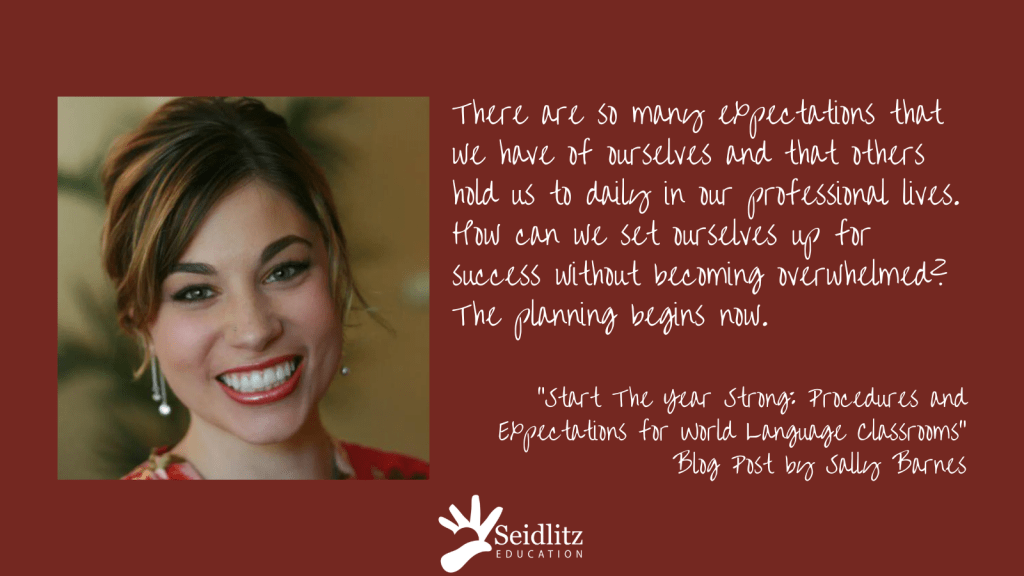
Start The Year Strong: Procedures and Expectations for World Language Classrooms

by Sally Barnes

  • “Stay in the target language 90% of the time.”
  • “Take attendance every day.”
  • “Refer back to your daily objective throughout the lesson.” 
  • “Conduct formative assessments throughout the day to check for student understanding.”

There are so many expectations that we have of ourselves and that others hold us to daily in our professional lives. How can we set ourselves up for success without becoming overwhelmed? The planning begins now, before the students walk into the classroom, in order to start the year strong. Here are some ideas to prepare for the upcoming school year! 

Continue reading “Start The Year Strong: Procedures and Expectations for World Language Classrooms”

Conexiones metalingüísticas: A propósito—no de chiripa

Sin querer queriendo…El Chavo del Ocho

Aloise Miller

Siempre he sido multilingüe. Me es realmente imposible contestar, “¿cuál es tu primer idioma?” Con mi mamá, hasta la fecha, me comunico en español y con mi papá, en inglés. Durante los primeros siete años de mi vida viví en CINCO países y estuve expuesta a más de cuatro idiomas aparte del inglés y español, y desde el segundo grado de primaria, toda mi educación fue bilingüe. Sólo sé lo que es ser multilingüe y agradezco la fortuna de la vida por haberme dado la oportunidad de crecer hablando más de un idioma y de ser educada en dos idiomas.

Continue reading “Conexiones metalingüísticas: A propósito—no de chiripa”

ELL? EL? EB? MLL? CLD? How Labels Help — and Hurt — Students

by Dr. Stephen Fleenor

When I became an educator ten years ago, it was in the wake of a concerted push within the education community to shift away from deficit-minded language toward more asset-based language, particularly in the service of students acquiring English proficiency. I felt a sense of pride and optimism that we had almost completely shifted away from the deficit-based label, “Limited English Proficiency” (LEP), toward the more asset-based label, “English Language Learner” (ELL). 

Continue reading “ELL? EL? EB? MLL? CLD? How Labels Help — and Hurt — Students”

Short Structured Role-Play

by Dr. Lora Beth Escalante

My son’s favorite page, and also his favorite voice to do (Mama Worm).

Have you read Diary of a Worm (Cronin, 2003)?  I have enjoyed it, possibly a hundred times, with my kids. It’s one of our favorites. I have even eyed it across the couch and picked it up to thumb through by myself. Yep. I find it endearing and whimsical, imagining what life could be like as a worm. I have no legs, yet my best friend is a spider with eight of them! I was cozy underground but forced to abandon my home in haste when a torrential rain threatened to drown us. Seeing the nuances of how a worm uniquely performs everyday tasks, such as holding a pencil (with a tail), sleeping (with leaves as bedsheets), and dancing the hokey pokey creates a silly connection with my everyday tasks as a human. There are other books in this series and countless other titles written from unique perspectives. (I often choose my own books based on the perspective from which they are written, too. When narrators shift each chapter, I look forward to how each character reacts internally and externally to the events in a story.) 

Continue reading “Short Structured Role-Play”

Finding Literacy in Math

by Diane Kue

When I was an elementary classroom teacher, I was often told that my students needed to read in every subject because “there is reading in every content area.” I could see how reading research could have a place in instruction when my students navigated scientific practices, but what about when the class period was looking at data instead of reading an article? Furthermore, the “there is reading in every content area” statement was especially hard to wrap my head around in my math class. Why did I have to give literacy so much clout in my instruction when my objective was teaching equivalent fractions? 

Continue reading “Finding Literacy in Math”

Help Newcomers Tell Their Stories

by Elise White Diaz

It is March. Your class is settled and you are either gearing up for (or in the midst of) State Testing. You have been working with your multilingual students all year, and they are ready. Just as you breathe a sigh of relief and find your footing, the announcements come: a new student from out of the country is waiting in the office for you. Then another, and another. Now the question becomes, how do we integrate these newcomers into the class and curriculum when they are so far behind the language levels of their peers (who have been here all year)? The answer is so simple and intuitive it almost feels too easy: allow beginning language learners to express themselves through pictorial representation, then leverage co-created text to engage them in all four language domains.

Continue reading “Help Newcomers Tell Their Stories”