Meet the Author: 17 Stories

Steve Davidson’s 17 Stories: Students Finding Meaning Through Teaching and Service debuted from Seidlitz Education this summer. This inspirational book highlights the power students have to make a difference—for themselves and for their communities—when they’re encouraged to find meaning and passion in service. 

17 Stories is a collection of testimonies from Davidson’s students about their personal experiences with service and the impact it has had on their lives. As the common denominator behind these students’ success, Davidson is clearly an educator to be reckoned with. As John Seidlitz says in the foreword to 17 Stories, “He has the biggest heart for his students I think I’ve ever seen, and he’s a very unorthodox, out-of-the-box thinker.” 

But don’t take our word for it. We wanted you to have a chance to meet Steve Davidson firsthand. So here he is, introducing himself, the service program he created, and the book that we can’t wait to share with you later this summer.

Continue reading “Meet the Author: 17 Stories”

Three Tips for Successful Summer Professional Development

by Stephen Fleenor

We made it! Another school year has passed, testing season is finally over, and summer is upon us! This time of year often feels like the end of a chapter, with a whole mix of emotions: excitement about the summer (and maybe the next school year), relief from the exhaustion and stress, and perhaps even grief about moving on from these students and this teaching assignment into a whole new year. So when we start to see the conferences, workshops, and professional development offerings on the summer calendar, we naturally have a variety of reactions. For some of us, it’s a welcome opportunity to finally reflect on our practice outside of the stress and bustle of the school year. For others, it’s merely a requirement of our jobs, and we can imagine many other things we’d rather be doing, as what’s happening over the next two months (or even tomorrow) isn’t even on our radars.

Regardless of where our heads are at during professional development this summer, there is  great potential to have a major impact on the next year (and we may even catch ourselves smiling, too!). Here are three tips for having an enjoyable, productive experience with PD this summer.

Continue reading “Three Tips for Successful Summer Professional Development”

Language Exchange Club: Providing Emergent Bilingual Students with Opportunities to Participate in Extracurricular Activities

by Elise White Diaz

Research shows that when students involve themselves in extracurricular activities, their academic performance soars (Hollan, 1987). Fowler Middle School in Plano, Texas, exemplifies this. The school is known locally for its high STAAR scores and high-performing population. So much so that families move into its zoned neighborhoods just so their children can attend this remarkable school. Yet despite its success, when the school’s Special Populations committee convened and looked at the data, they discovered that not all subgroups of the student population were well represented in extracurricular activities—emergent bilinguals in particular—and that most of the clubs offered catered to already high-performing students. With these findings in mind, Fowler Middle School launched the Language Exchange Club.  

Continue reading “Language Exchange Club: Providing Emergent Bilingual Students with Opportunities to Participate in Extracurricular Activities”

Minimax Principle and Secondary Long-Term English Learners

by Natalia Heckman

If you are an ESL teacher, you have probably heard about Stephen Krashen. If you are an administrator, you have probably heard about John Hattie. If you have ever attended a campus accountability meeting, you must be familiar with the phenomenon of language stagnation. So what do Krashen, Hattie, and language stagnation have in common? They are connected through the principle of MINIMAX (maximum return on minimum investment).

Continue reading “Minimax Principle and Secondary Long-Term English Learners”

Who Are Gifted Multilingual Learners and How Do We Support Them?

by Marcy Voss

I noticed that Diego was the first student in the eighth-grade math class to finish the assignment. He was a quiet and respectful student who did not volunteer to speak in class because he had difficulty pronouncing academic math terms like “slope” and “y-intercept.” However, Diego willingly helped the student paired with him to correct mistakes and complete the math problems. As he was one of “my students” in my job as an English Learner Coach, I was to support Diego during class instruction to help him gain language proficiency and achieve academic success. Diego was in his first full year in US schools, having arrived at the end of the previous school year. I was told he was educated in his home country and had aspirations of becoming an engineer. This alerted me to the fact that he was motivated to learn. 

Continue reading “Who Are Gifted Multilingual Learners and How Do We Support Them?”

The Role of Perspective in the Math Classroom

by Diane Kue

Mathematics has existed in every civilization throughout history. Its worldwide presence is why so many people claim it as a universal language. Further perpetuation of the claim is present in the classroom. A classroom full of students who may or may not all speak the same language can successfully and individually solve the same problem. After all, doesn’t 1 + 1 = 2 everywhere, no matter the language, country, or culture if the symbolic representation shows that one whole, joined with another one whole, makes two wholes?

However, the idea that math is a universal language because the answer to a problem is always the same no matter what language is spoken can be misleading. This notion focuses on the answer; it does not acknowledge that the processes to solve for the answer—or even the perspectives on the processes—can vary. When we focus on the processes to solve, we can discover and unveil various perceptions on or ways to look at problem solving. We find the whys behind the hows of problem solving. 

Continue reading “The Role of Perspective in the Math Classroom”

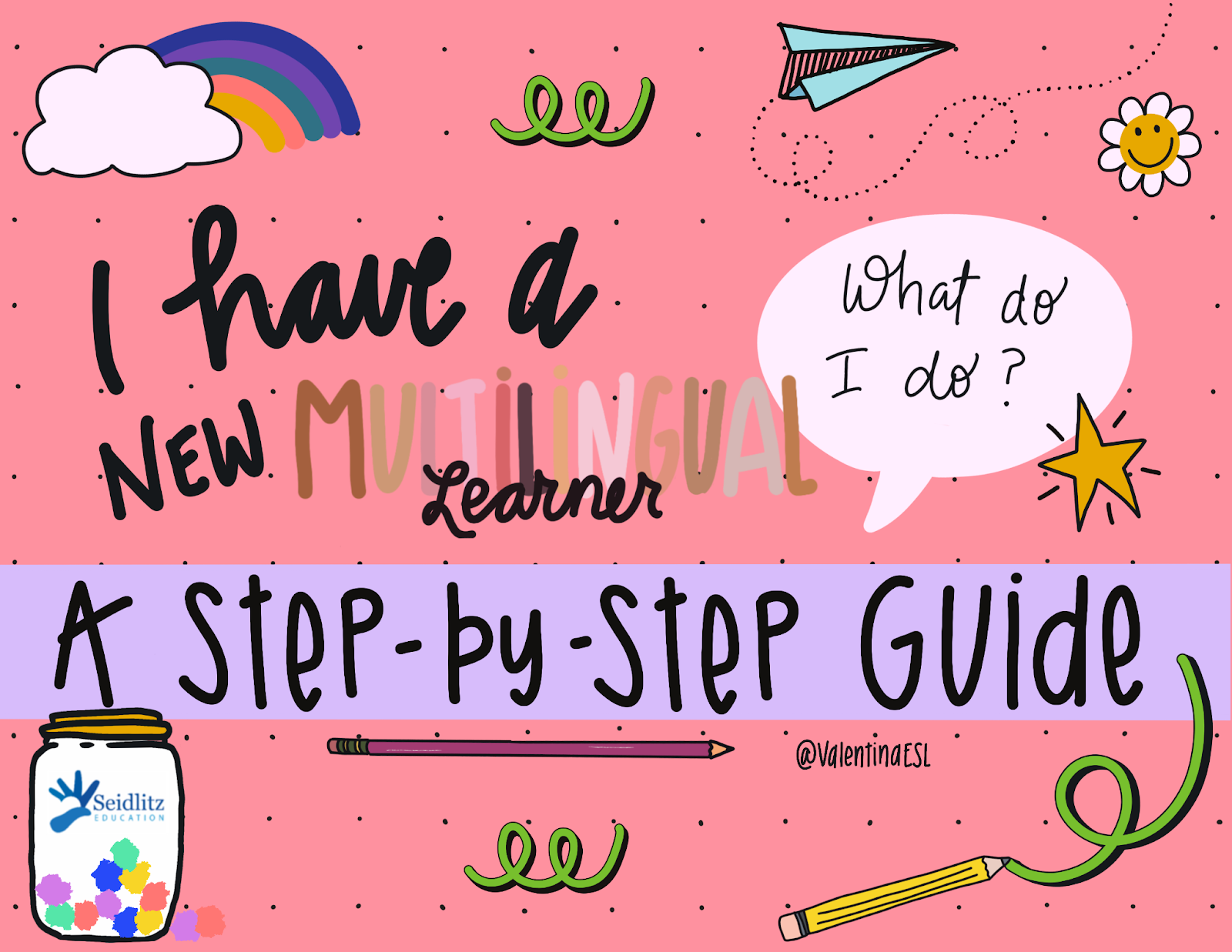
I Have a New Multilingual Learner. What Do I Do? A Step-By-Step Guide

by Valentina Gonzalez 

The quality and quantity of preservice instruction in teaching multilingual learners vary, leaving many teachers feeling inadequately prepared. And even those who did receive some training may have never had practical experience applying what they learned. 

Well-intentioned teachers with their hearts in the right place are often left feeling overwhelmed as they think about how to best give newly arrived multilingual learners all they need to succeed. 

This step-by-step guide offers tips for teachers preparing to welcome newly arrived multilingual learners in all grade levels. 

Continue reading “I Have a New Multilingual Learner. What Do I Do? A Step-By-Step Guide”

Not All Visuals are Created Equal (or Equitable)

by Stephen Fleenor

Visual aids have long been recognized as a powerful instructional accommodation for diverse groups of learners. Indeed, whenever I ask educators how to best support language learners, learners with special needs, gifted and talented learners, or learners with limited or interrupted formal education, the most common answer I hear is visuals. Not surprisingly, whenever I ask educators which instructional strategies generally help students learn best, I get the same response.

Continue reading “Not All Visuals are Created Equal (or Equitable)”

The Effects of Noise Pollution on Learning in a Multilingual Classroom

Do You Hear What I Hear? 

by Natalia Heckman and Aloise Miller

From Natalia Heckman

Noisy classrooms do not always equal engagement. The idea for this blog came into focus after my recent conversation with my dear colleague and friend Aloise Miller. Flying over Texas, we chatted about voice levels, music selection, and classroom noise overall. The topic of this blog is noise pollution. Not the sound of students collaborating in groups or with partners. Not the sound of students playing games or enthusiastically debating a hot topic. We all know that kind of noise is good! Instead, we discussed the other kind of noise: the unnecessary kind.

Continue reading “The Effects of Noise Pollution on Learning in a Multilingual Classroom”