Visual aids have long been recognized as a powerful instructional accommodation for diverse groups of learners. Indeed, whenever I ask educators how to best support language learners, learners with special needs, gifted and talented learners, or learners with limited or interrupted formal education, the most common answer I hear is visuals. Not surprisingly, whenever I ask educators which instructional strategies generally help students learn best, I get the same response.
Continue reading “Not All Visuals are Created Equal (or Equitable)”The Effects of Noise Pollution on Learning in a Multilingual Classroom
Do You Hear What I Hear?
by Natalia Heckman and Aloise Miller
From Natalia Heckman
Noisy classrooms do not always equal engagement. The idea for this blog came into focus after my recent conversation with my dear colleague and friend Aloise Miller. Flying over Texas, we chatted about voice levels, music selection, and classroom noise overall. The topic of this blog is noise pollution. Not the sound of students collaborating in groups or with partners. Not the sound of students playing games or enthusiastically debating a hot topic. We all know that kind of noise is good! Instead, we discussed the other kind of noise: the unnecessary kind.
Continue reading “The Effects of Noise Pollution on Learning in a Multilingual Classroom”It Doesn’t Apply to Me
I’ll start this off with a confession: a good number of my first years in teaching, I would sit through days/weeks/months of training I was obligated to attend and think to myself, “Yeah…but this doesn’t apply to me.”

Using Prompts and Sentence Stems to Expose Mathematical Thinking When Problem-Solving
by Diane Kue
How students solve a problem—whether it is a standalone equation, expression, or a word problem—can be quite perplexing, especially when answers are unexplained. Students’ approaches and strategies vary, and their foundations of knowledge span a wide spectrum. It is probably truer than not that a mathematics teacher has come across the following scenario:
Teacher: How did you solve this problem?
Student: I don’t know. I just did it.
Whether the answer to a problem is correct or not, the pedagogical dilemma in this scenario is gaining access to student thinking so we can address misconceptions and incompleteness as necessary and validate or guide further application. But how do we get our students to use language to convey their mathematical thinking?
Continue reading “Using Prompts and Sentence Stems to Expose Mathematical Thinking When Problem-Solving”Total Response Signals in the Secondary Classroom
by Sally Barnes
As a secondary teacher, Step 4 from the 7 Steps to a Language-Rich, Interactive Classroom was always the one I was most “lukewarm” in implementing. The idea of my 16-year-old students collectively giving me a thumbs-up or standing back-to-back seemed unrealistic. In my mind, I felt like I would get the same students giving me a thumbs-up that would normally verbally tell me they were good to go, or they’d show me they were ready because they had stopped working.
Continue reading “Total Response Signals in the Secondary Classroom”Welcome Diverse Students on the First Day of School
There is something deep inside each person that makes them want to be wanted, invited, and chosen. I saw it on my daughter’s face as she lit up when her new teacher leaned down and whispered in her ear: “I wanted you too…” This was an easy thing to communicate to a nine-year-old. They spoke the same language and were from the same culture, and my daughter has a healthy attachment to me, her mother (so far at least—fingers crossed). She is accustomed to an adult woman leaning down to whisper in her ear, and to her, it means a healthy intimacy. But what if this was not the case? What if my daughter and her new teacher did not speak the same language? What if there was a cultural disconnect between the teacher and the student’s greetings and use of personal space? What if the student had experienced trauma from their mother figure, and a whisper in the ear was reminiscent of abuse instead of healthy intimacy? How do we welcome diverse students on the first day of school in a way that will help them to receive the message that they are wanted, chosen, and accepted?
Continue reading “Welcome Diverse Students on the First Day of School”Don’t Just Call Them What You Will: Names
by Valentina Gonzalez
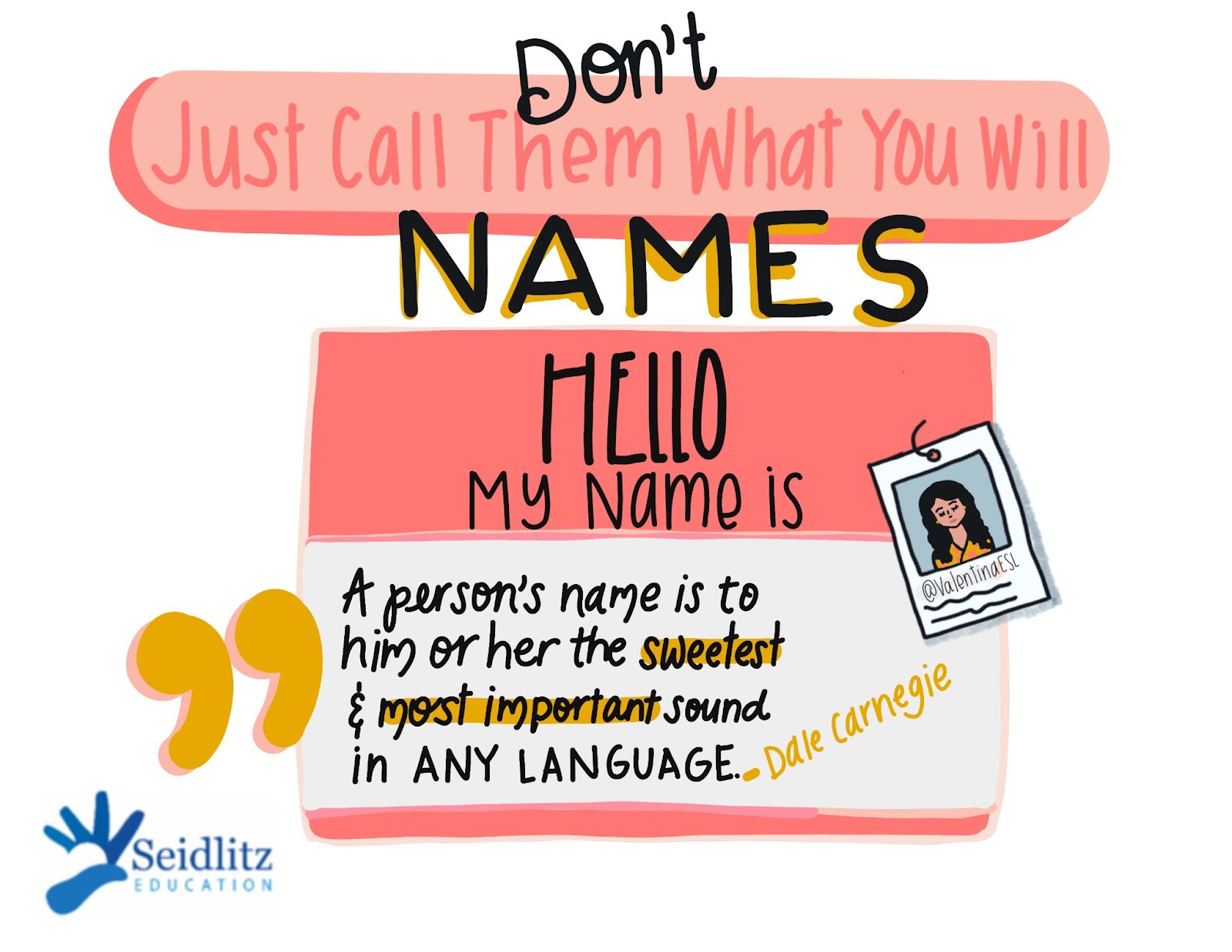
“A person’s name is to him or her the sweetest and most important sound in any language.”
Dale Carnegie
Many people take great pride in their names and in naming their children.
Today, I take a lot of pride in my name, but it wasn’t always that way. In fact, for a long time, I wished my name was something more…American. When I started school in America, the teacher wrote out our full names on desk plates. There was mine, “Valentina Najdanovic.” It was long and barely fit on the desk. It was hard to read, much less spell. When the teacher pointed to my last name with squinty eyes and her mouth in an uncomfortable gappy stretch and asked me, “How do you say that?” I was embarrassed. And at that age, I saw my name as an inconvenience. It was clunky. And it didn’t fit in. And that made me feel that I didn’t fit in.
Continue reading “Don’t Just Call Them What You Will: Names”Coaching All Content Areas with a Language Focus
After six years of teaching math and science in bilingual classrooms. I was invited to take on the role of instructional math coach in my district (San Marcos).
As I was on my coaching journey, I received a lot of support from my coworkers and had the privilege of being trained by education leader and coaching expert Jim Knight. With Jim, I learned that as soon as we as teachers stop learning, the students stop learning as well. In San Marcos, we used Jim’s coaching model to facilitate better conversations among educators. During these conversations, I got to know and connect with my teachers better and constantly reflect on instruction with teachers as we worked through coaching cycles.
Continue reading “Coaching All Content Areas with a Language Focus”Improving Outcomes for Emergent Bilingual Students: Scaffolding Up
by Valentina Gonzalez
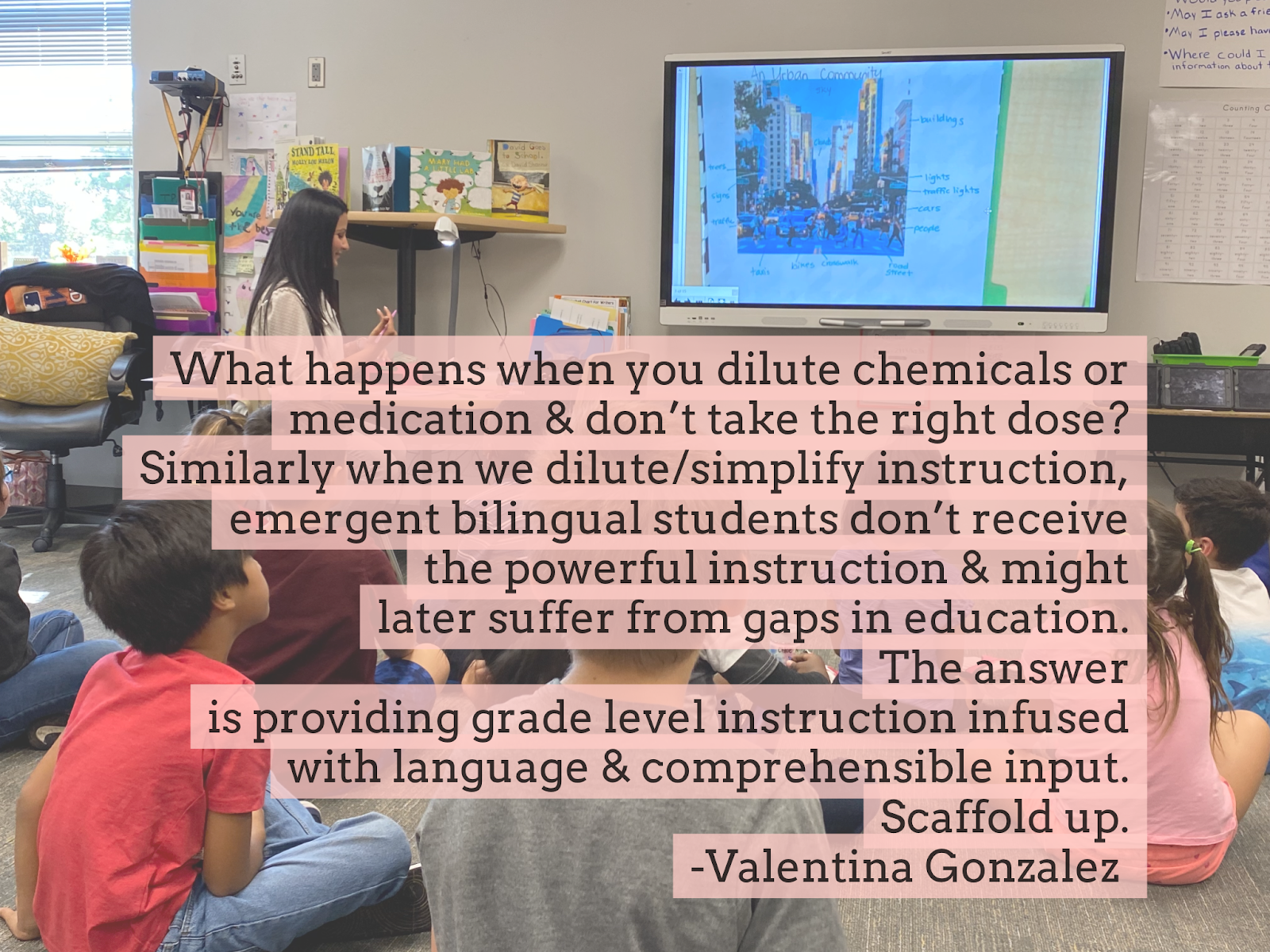
Imagine you have been prescribed medication with a daily dosage to help control your blood pressure. Let’s say 50 mL in the morning and 50 at night. However, you decide the pills are too large and uncomfortable to swallow. You reduce the dosage by half daily and mix it with water. The first day you feel great, no change noticed. Second day, same. But over time, something happens. Suddenly there is a difference—a decline—in your health. Why?
Grade-level curriculum is like a prescribed dosage for all students, including monolingual and emergent bilingual students alike. Over time, emergent bilingual students who regularly receive diluted instruction are at risk of not meeting the requirements to exit ESL programs and, as a result, becoming classified as long-term English learners. Oversimplification of instruction leaves out critical academic vocabulary and important elements of content that may be necessary for subsequent learning, classes, or grade levels.
Continue reading “Improving Outcomes for Emergent Bilingual Students: Scaffolding Up”Planning for Purpose: What Can ALL Students Do?
By Sally Barnes
It’s that time of year again! We get to sit by the pool, read the books we’ve collected over the past few months, spend time with friends and family, and maybe get a few minutes to reflect on our year and think about what’s to come. The last couple of years have been an adventure and have really forced me to revisit my initiative as a teacher, particularly asking what can my students do, and what are they doing?
Continue reading “Planning for Purpose: What Can ALL Students Do?” Seidlitz Education