by Diane Kue

Step 3 of Seidlitz and Perryman’s (2021) 7 Steps to a Language-Rich, Interactive Classroom is all about randomizing and rotating student responses during whole-class instruction and group tasks to maintain engagement and accountability. Although I spend more time training other steps, the Step It Up! differentiation for Step 3 on page 40 is my favorite page to present to educators (Seidlitz & Perryman, 2021). In lieu of teachers randomizing and rotating which students speak, students self-regulate using Talking Chips. The purpose is to engage all participants within a group with the opportunity to express their thinking.
The Evolution of Talking Chips
Talking Chips were first developed by Spencer Kagan (1992) as a tool for cooperative learning . Over the past thirty-plus years variations in application have evolved, but its purpose of engagement and accountability of the individual within a group dynamic remains steadfast. The sentence stems, “I respectfully disagree. I think…” and “So far we’ve talked about…” enrich whole-class discussions as each student would “cash in” their unique discussion chip.
As a classroom teacher, the novelty of individual, unique sentence starters for each student contrasted with my previous structure of all my students using the same sentence stems, such as, “I think… I wonder… I noticed…” It transformed group engagement and gave me a new lens for teaching reading response. I perpetuated the success with mathematics- and science-focused Talking Chips as well.
Exploring a New Purpose
Heckman (2023) writes, “Discourse is language beyond a sentence” (p. 66). With practice, the shift from one-sentence responses to engaged academic conversations was a thrill to observe in my students. I began to brainstorm further. How might I use Talking Chips not only to normalize academic discourse but also to raise language proficiency?
When I worked for my district’s ESL Department, I collected data from a collection of school’s student language progressions over time. Results from the Texas English Language Proficiency Assessment System (TELPAS) showed that the average scores of students who entered U.S. schooling at the beginning level for speaking rapidly rose to an intermediate level within their first year. However, they would consistently plateau between their first and second year, remaining at the intermediate level before gradually rising towards another proficiency level.

Heckman (2023) writes in greater detail, research about the intermediate-level plateau and the need for explicit language instruction, and this need is what I will address with Talking Chips. If you, your school, or your district have similar issues—that is, you have a cohort of students whose language acquisition seems to have reached an impasse—then you might find applying Talking Chips with a focus on raising proficiency levels beneficial.
Fostering Communicative Skills By Raising Language Proficiency
I began by categorizing my sentence stems into four levels: beginning, intermediate, advanced, and advanced high*. I created sentence stems with simple present tense for students at the beginning of acquiring English.
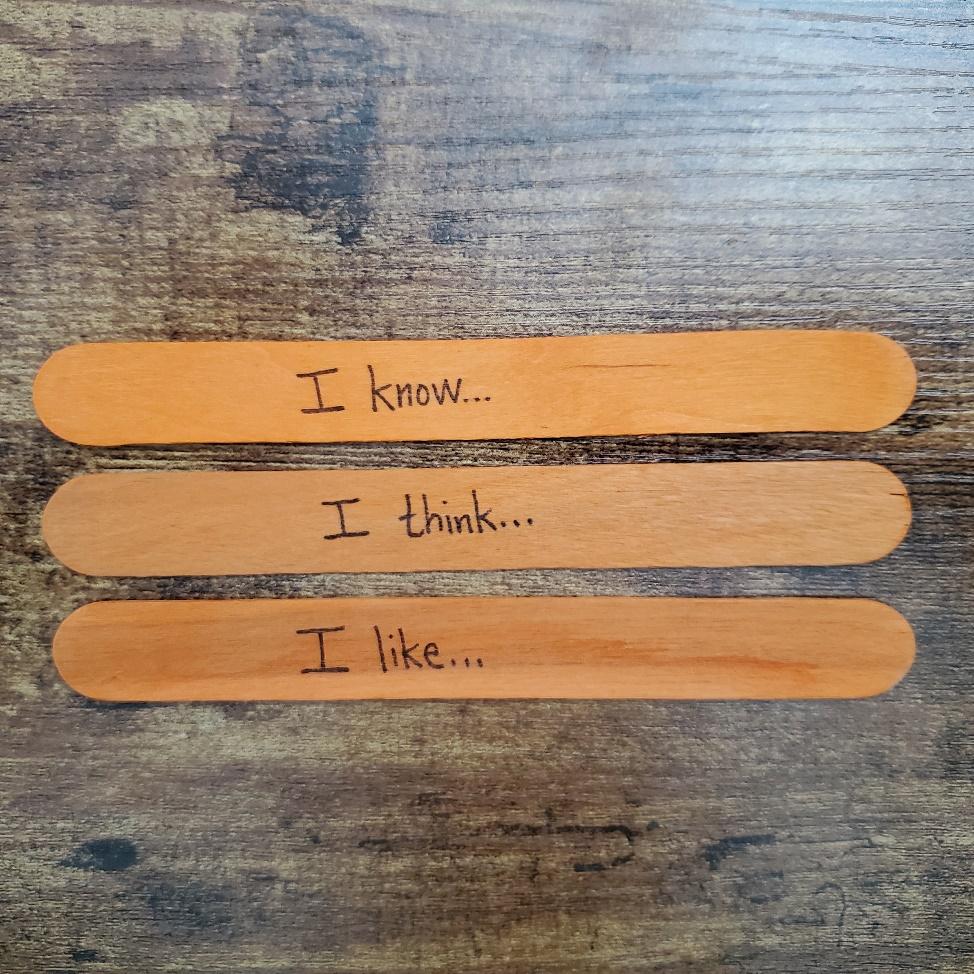
For the intermediate level speaker, I created sentence stems with simple, present, present continuous, and past tense for students who can speak in simple present tense. The word because is important to these sentence stems because the speaker must reflect on their understanding before explaining or justifying their response. It requires more language.
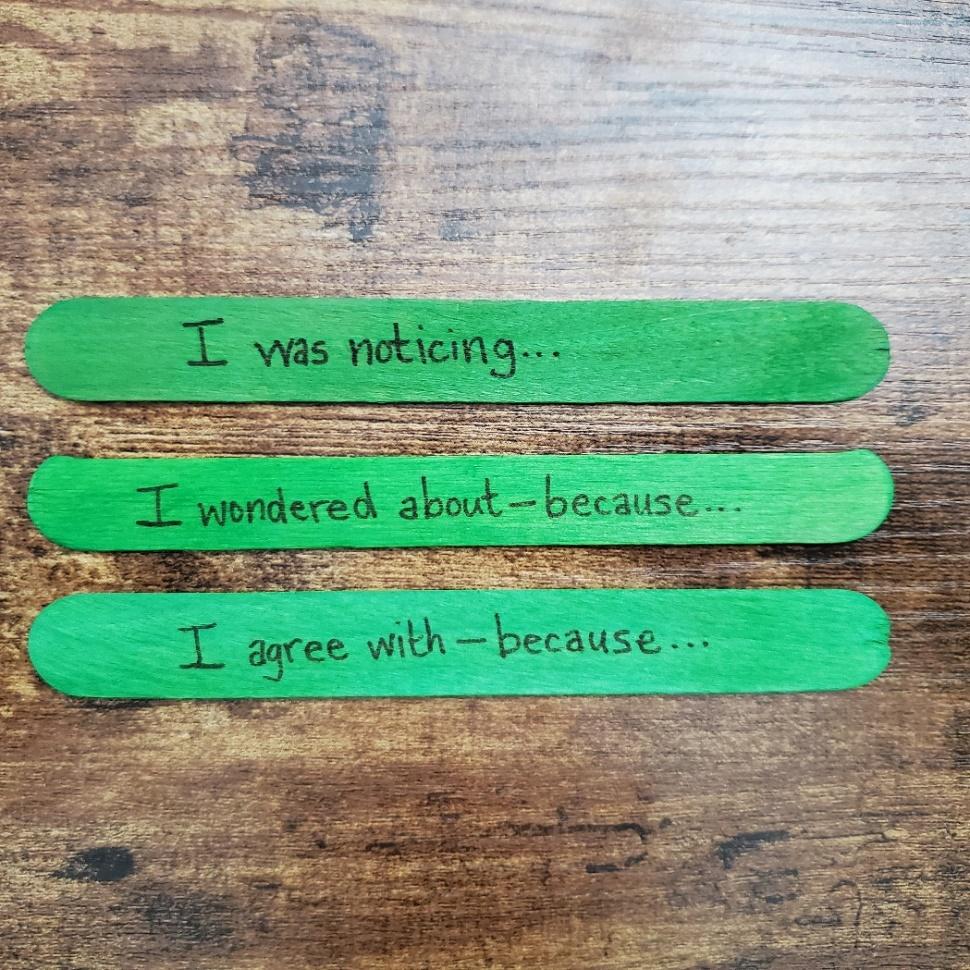
For the student speaking at the advanced level, I created sentence stems with a variety of sentence tenses and more complex grammatical structures, such as future tenses and prepositional phrases, to explain their reasoning. These stems include idioms and figurative language and have more abstract prompts.
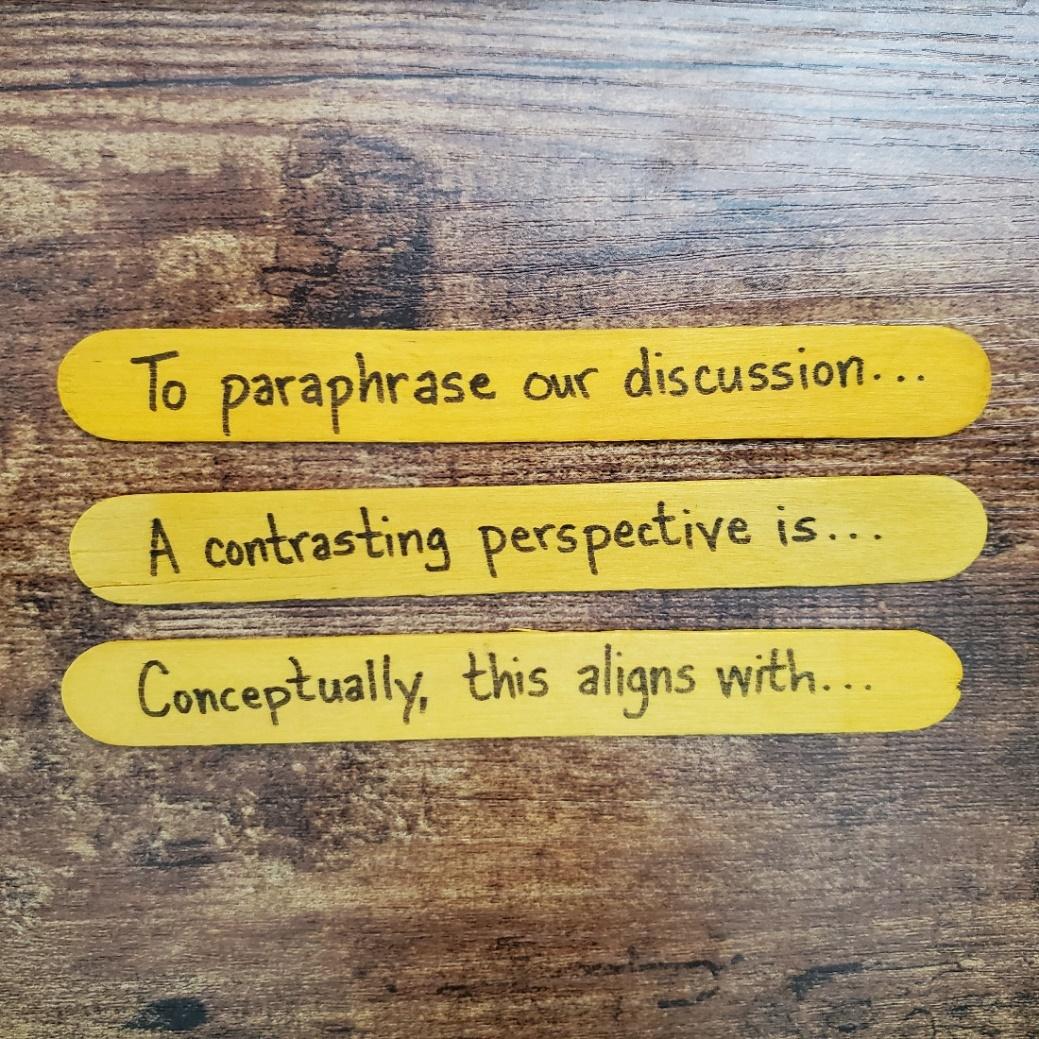
Speakers using the advanced Talking Chips usually do not start the conversation as the chips move from concrete to abstract sentence stems that prompt explanations. Speakers at the advanced level understand the language of a concept enough to paraphrase it or be able to give comparative or contrasting examples.

For students with an advanced high speaking level, I created sentence stems with a variety of sentence tenses and more complex grammatical structures, such as dependent clauses, for students who can explain their thinking abstractly.
Speakers cannot begin conversations with these stems. Instead, they absorb the language of the conversation as it evolves and abstractly make connections to ideas and perspectives within the conversation before communicating.
Application

Ector County ISD
There are a variety of ways to employ the use of Talking Chips, and I present three-hour sessions that focus solely on methods for manipulating the chips. One simplified version is to let the students select which chips they want to use during their conversations. It was a way I could evaluate their self-assessed comfort levels and speaking proficiencies. I would record their choices and find ways to encourage the next proficiency level Talking Chips over time. There was much more to this process, but my point is to give you an idea of how raising proficiency can be implemented. Other ways Talking Chips can be implemented are:
- During Talk #2 in Motley’s (2016) Talk, Read, Talk, Write structure
- To support mini-lessons in reading and writing (Gonzalez & Miller, 2020)
- As a means of surpassing the “developing writer’s threshold” (Heckman, 2023, p. 22)
- To explain process thinking when jigsawing a word problem (Kue, 2023)
- To engage in science-specific academic discourse (Fleenor & Beene, 2019)
By strategically focusing on sentence tenses and sentence starters that practiced engaging in discourse, students not only acquired language, but they also acquired communicative skills applicable to success beyond the classroom.
Diane Kue is the author of Solved: A Teacher’s Guide to Making Word Problems Comprehensible.
*This assessment system is similar to what states outside of Texas use to measure growth in English proficiency (WIDA, ELPA21, etc.).
Sources
Fleenor, S., &Beene, T. (2019). Teaching science to English learners. Seidlitz Education.
Gonzalez, V., &Miller, M. (2020). Reading & writing with English learners. Seidlitz Education.
Heckman, N. (2023). Building better writers. Seidlitz Education.
Kagan, S. (1992). Cooperative learning. Kagan Cooperative Learning.
Kue, D. (2023). Solved: A teacher’s guide to making word problems comprehensible. Seidlitz Education.
Motley, N. (2016). Talk read talk write: A practical routine for learning in all content areas (K-12) (2nd ed.). Seidlitz Education.Seidlitz, J., & Perryman, B. (2021). 7 Steps to a language-rich, interactive classroom. Seidlitz Education.

 Seidlitz Education