
by Jim Ewing
For many Texas educators, the rollout of the updated English Language Proficiency Standards (ELPS) and Proficiency Level Descriptors (PLDs) scheduled for Fall 2026 may feel like “one more thing” on an already full plate. However, these standards are not an add-on—they are a roadmap for intentional instruction.
The updated ELPS now include content-specific PLD examples for math, science, and social studies content-areas, offering teachers clearer guidance than ever before. Instead of relying solely on broad descriptors, educators now have a structured way to support students across five proficiency levels while maintaining rigorous academic expectations.
While these are required in Texas, educators across the country can also use this framework to better support Emergent Bilinguals (EBs) in math classrooms.
Busting the “Universal Language” Myth
A common misconception is that “math is a universal language” and therefore does not require explicit language instruction. Mathematics, particularly word problems and abstract reasoning, require strong receptive and expressive language skills.
We are not just teaching math; we are developing students’ ability to listen, speak, read, and write about mathematics.
The New ELPS: Your Planning Roadmap
The ELPS are state-mandated guidelines that support instructional planning. They outline how to integrate language development into content instruction. Just as the TEKS guide content instruction, the ELPS guide how teachers support students’ language development within that content.
The updated ELPS are organized into two grade bands, K–3 and 4–12, providing clearer guidance across developmental stages. To make application of the ELPS easier, teachers can refer to the PLDs for assistance.
What Are PLDs?
PLDs describe what students can do at different stages of language development. They assist teachers in offering effective language support and scaffolding for differentiation.
The revised framework describes five proficiency stages: Pre-Production, Beginning, Intermediate, High Intermediate, and Advanced. These stages offer a clearer guide for helping Emergent Bilinguals. The Pre-Production level provides enhanced support for newcomers, who might not be ready to communicate in English but nonetheless can still participate in mathematical thinking.
General vs. Content-Specific PLDs
One shift we see is that the updated ELPS guidance includes content-embedded PLDs. It is important to understand that these descriptors do not replace the general language proficiency levels; rather, they provide examples of how those general PLDs appear within the context of mathematics instruction.
While they offer a content-specific lens to better understand language development in math, not all general PLDs are represented within these examples. All teachers remain responsible for addressing the full set of general PLDs, using these content-embedded examples as support rather than a substitute.
A Supporting Resource: The Visual Non-Glossary
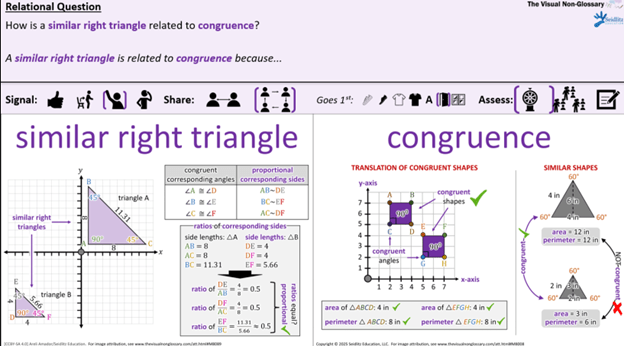
Figure 1. Visual Non-Glossary example illustrating similar right triangles and congruence with built-in language supports.
Using the Visual Non-Glossary (VNG) as a resource, teachers can support both mathematical understanding and language development simultaneously. While the content goal is to explain how similar triangles relate to congruence, teachers can also use the ELPS as a guide to intentionally develop each student’s academic language. For grades 4–12, one of the Speaking ELPS, (d)(2)(E), focuses on students justifying their ideas in academic contexts. Teachers can then use the PLDs to help students build and communicate mathematical arguments about similar right triangles. This approach reflects strong math instruction: Students use visuals to make meaning, explore multiple ways to explain their thinking, and communicate their ideas with increasing language complexity (Beene & Mendoza, 2022).
The following table, taken from the most recent ELPS Flip Book (Hand & Seidlitz, 2026), demonstrates how teachers can use the PLDs to help EBs at various proficiency levels justify their mathematical arguments under the Speaking Standard (d)(2)(E) using the Visual Non-Glossary:
| Proficiency Level | What the PLDs Say | What It Looks Like in Math (Using VNG) |
|---|---|---|
| Pre-Production | May communicate mathematical ideas through gestures and a few isolated words | Points to visuals in the VNG to show that two sides are congruent. |
| Beginning | Can describe mathematical ideas and reasoning orally through isolated words and mathematical terms. | Uses a sentence stem and adds one or two words, with heavy reliance on pointing to visuals in the VNG to support and communicate mathematical ideas. |
| Intermediate | Can describe and justify orally mathematical ideas and reasoning using high-frequency mathematical terms and phrases. | Uses sentence stems from the VNG and adds several words to build a complete sentence describing how similar right triangles relate to congruence, relying more on language and less on pointing to visuals. |
| High Intermediate | Can use sentences to orally describe and justify mathematical ideas, reasoning, arguments, and application of multiple representation, including symbols, diagrams, and graphs. | Uses complete sentences to explain and justify how similar right triangles relate to congruence, and begins to incorporate multiple representations from the VNG to support reasoning. |
| Advanced | Can use sentences and precise mathematical language to explain and justify mathematical ideas, reasoning, arguments, and applications of multiple representations, including symbols, diagrams, or graphs. | Uses precise mathematical language to justify reasoning about similarity and congruence, incorporating multiple representations from the VNG (e.g., charts, symbols and graphs). |
Across all levels, students engage in the same task but demonstrate their thinking in different ways, showing that language development and mathematical reasoning can grow together. Students tackle a challenging math task, using language supports suited to their proficiency.
Common Misconceptions About the New ELPS and PLDs
- “There are new standards just for math.” — False. The ELPS have been updated, but not as separate math-only standards. What’s new are the PLDs, which now include content-specific examples for math, science, and social studies.
- “If I teach math, I only need the math PLDs.” — False. Content-specific PLDs provide helpful guidance, but teachers must still use the full set of ELPS and general PLDs.
- “Now I have to learn a whole new system.” — Not necessarily. The updates focus more on organization and clarity, including the addition of K–3 and 4–12 strands.
- “ELPS are only for English teachers.” — False. Language development is essential in every classroom. These standards support all teachers working with Emergent Bilinguals.
Final Thoughts
The new ELPS and PLDs aim to ensure all students access challenging, grade-level math content. While these standards are required for Texas teachers, the framework serves as a helpful guide for high-quality instruction everywhere. Educators in any state can utilize these standards and descriptors to bridge language acquisition and mathematical mastery for any student, including Emergent Bilinguals.
With visuals, sentence stems, and appropriate scaffolds, we can teach math and language together. We can—and should—do both.
Ready to dive deeper into the 2026 updates? Check out our ELPS Flip Book, join us for our June 4 workshop in Houston, TX, or reach out to Seidlitz Education to learn about our trainings.
References
Beene, T., & Mendoza, A. (2022). Teaching math to English learners. Seidlitz Education.
Hand, A., & Seidlitz, J. (2026). ELPS flip book. Seidlitz Education.
Seidlitz Education. (n.d.) The visual non-glossary. https://thevisualnonglossary.com/

 Seidlitz Education