
by Isaac Márquez
“Well, Isaac. We can’t just make the work easier for them. We’re told there still has to be rigor.”
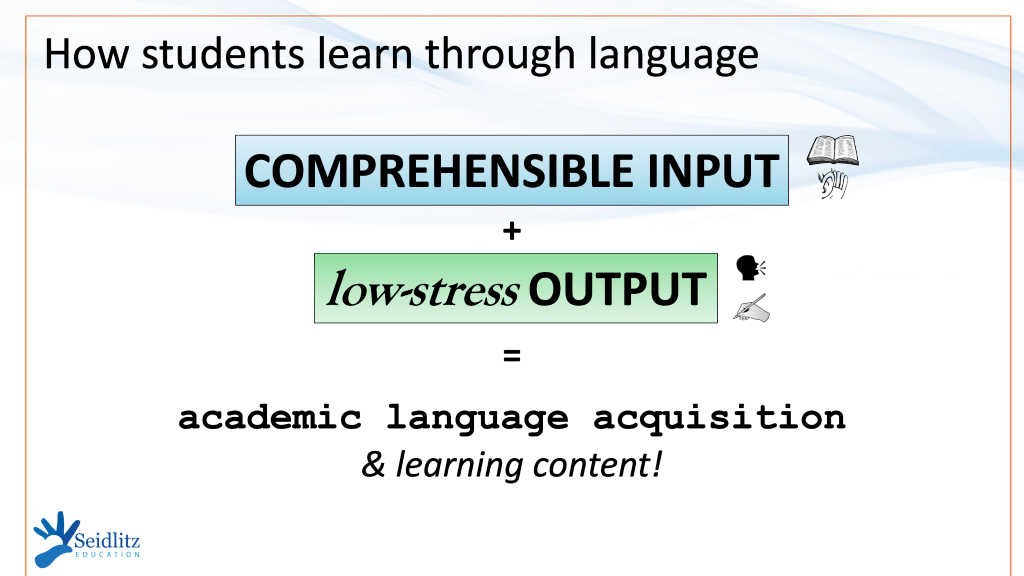
This is a comment I’ve heard from teachers a few times over the last couple of years that I’ve been at Seidlitz Education. During several of my sessions, I describe the ideas of Comprehensible Input and Low-Stress output. This brilliant concept of how students acquire language from Dr. Stephen Krashen and Dr. Merrill Swain is essential and foundational to successfully implementing strategies such as The 7 Steps to a Language-Rich, Interactive Classroom.
However, I’ve found that there is sometimes a misconception about what “low-stress” means.
What the Formula Actually Means
Before we even get to the output, we have to start with the first half of the equation. We know that students acquire language when they actually understand the messages they receive. This is comprehensible input. We as teachers do this all the time. We use visuals, gestures, real-world examples, and clear models to make the content accessible. If the input goes over their heads, learning stops right there.
And then comes the output. Merely understanding the input is not quite enough. Students actually have to produce the language to acquire it. But this is exactly where the misconception happens.
Lowering stress for this output is completely different from lowering expectations. When a student feels anxious about speaking out loud or getting the answer wrong, their cognitive load is entirely consumed by fear. They literally cannot process the academic content. Giving them opportunities for low-stress output clears that anxiety so they can actually tackle hard concepts and use language in a meaningful way. We can reduce the stress of performing or producing output without lowering the academic rigor.
Strategies for Lowering the Stress
We do not have to water down our lessons to make students feel safe; we just have to build in structure to lower stress. Here are a few ways to do that:
– Provide processing time: Give students a moment to process what you asked before expecting an answer. Silence in the classroom is often where the heavy lifting happens. A great way to ensure students have enough time to process without feeling embarrassed to tell us they need more time is to use a “reverse signal.” Ask students to show a signal first (such as pointing to the ceiling) and then to undo the signal when they’ve had enough time to process. This lets us know who still needs more time without having to ask them.
– Allow partner talk: Let them talk out an idea with a peer first. Testing an answer on one person is much less intimidating than performing for the whole room. This also allows students to learn from each other and to hear someone else use the target language. Additionally, even students with great answers sometimes feel unsure. But hearing a peer say “I was thinking the same thing!” boosts their confidence and sets them up for success if they’re asked to share their response with the class.
– Give a clear model: Show them exactly what a successful response looks and sounds like before you ask them to produce their own. This can be in the form of a well-thought-out rubric, the teacher modeling their own response, or a clear, accessible sentence stem.
Structure is Not a Crutch
Some teachers worry that using sentence stems or frames removes the rigor from an activity. I look at sentence frames as permanent, flexible structures that lower output stress and model appropriate language. They are beneficial for emergent bilingual students, students proficient in the target language, and even highly educated adults.
As a presenter, I’ve noticed that a majority of my participants use the sentence stems I provide when given the choice. They do not use them as a crutch. It proves that a sentence stem helps frame a response and lowers the stress of using unfamiliar language, all without sacrificing productive struggle or academic rigor. Providing the language students (or participants) need to start a sentence helps them focus their mental energy on the actual academic content.
Lower the Barrier, Keep the Bar High
When we remove the anxiety of not knowing how to start, students surprise us with what they are actually capable of. Ensuring output feels safe is exactly what allows us to keep the academic rigor high.
I often think back to those participants who worried we were making the work easier. I completely understand the hesitation. As educators, we want to challenge our students and prepare them for difficult academic tasks. We just have to separate the difficulty of the content from the difficulty of the process:
- Academic rigor is found in the complexity of thinking.
- Stress often comes from confusion about the task or fear of embarrassment.
If a student understands a complex concept but lacks the specific academic vocabulary to explain it from scratch, a blank stare does not mean they lack the knowledge. It usually means the language barrier is in the way. When we provide a sentence frame or a moment of partner talk, we give them a clear pathway to express that complex thought. The task remains demanding, and the student still has to do the heavy lifting of connecting the concepts. They just have a safe structure to help them communicate their ideas. When students know they have the support they need, they will step up to meet the challenge.


A powerful message about balancing academic challenge with a positive learning environment. Thank you for sharing this perspective.
LikeLike